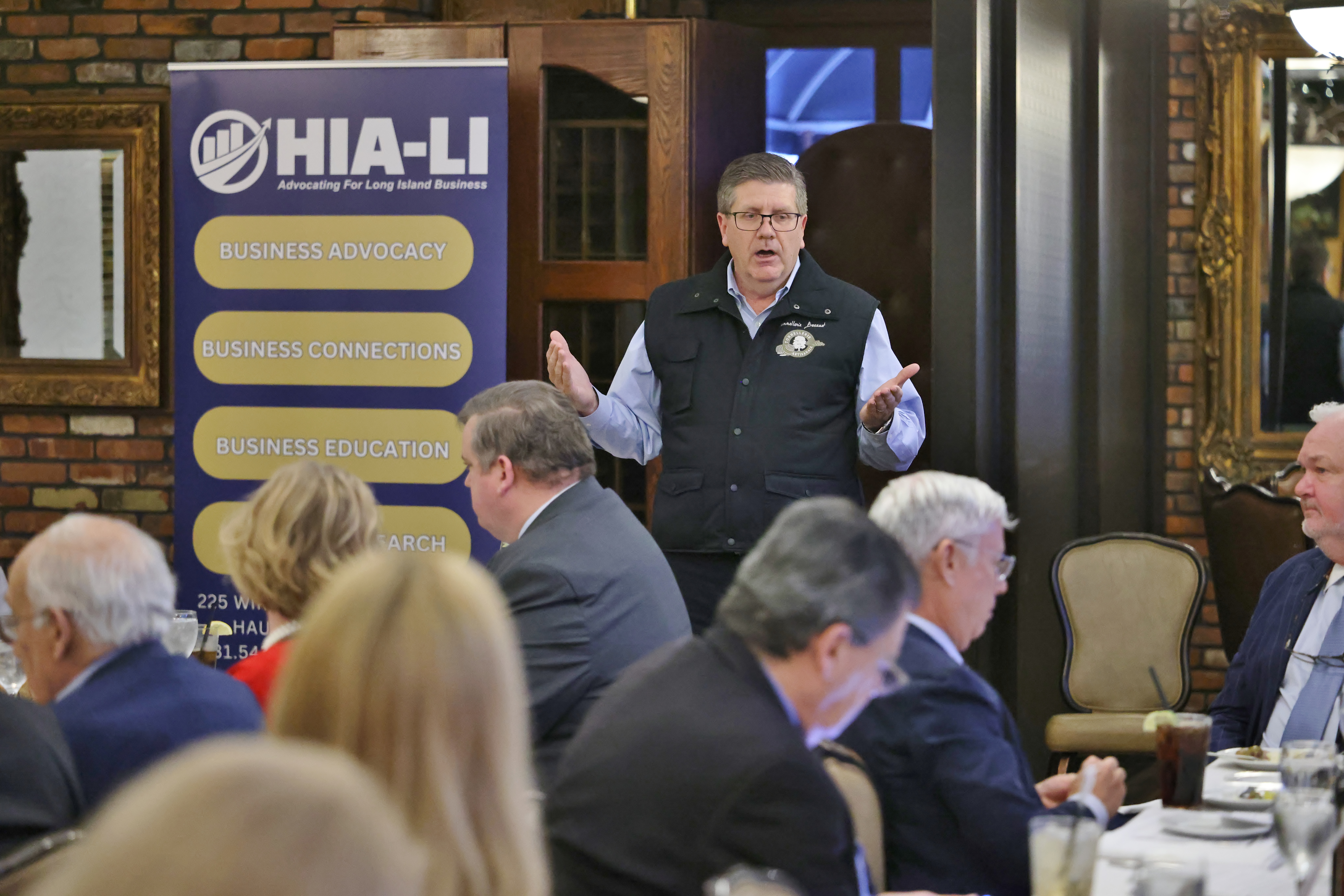
Long Island’s economic future will not be determined by any single project or policy. It will be shaped by the ability of leaders across the region — in business, government, and community organizations — to work together to advance bold ideas that strengthen our economy and expand opportunity. That spirit of collaboration was on full display last week when HIA-LI hosted its Economic Development Task Force dinner at Mama Lombardi’s in Holbrook.
Co-hosted by Strata Alliance — founded by HIA-LI Board Member Joe Campolo, Chair of HIA-LI’s Economic Development Task Force and Managing Partner of the Ronkonkoma-based law firm Campolo, Middleton & McCormick — the event brought together about 50 regional leaders, including roughly a dozen elected officials. The evening began with networking before transitioning to a dinner and discussion focused on Long Island’s economic opportunities and the work still ahead to fully realize the region’s potential.
One topic that consistently underscores Long Island’s economic strength is the Long Island Innovation Park at Hauppauge.
The park — the second largest industrial park in the United States after Silicon Valley — is something of a hidden gem in the regional economy. It represents one of Long Island’s most important employment centers and a powerful driver of economic activity, supporting tens of thousands of jobs and billions of dollars in economic output.
But the park’s true significance lies in the collaborative effort that continues to shape its future. Government leaders, economic development organizations, businesses, and community partners have worked together to position the park for continued growth and revitalization.
Town of Smithtown Supervisor Ed Wehrheim spoke about the town’s leadership in advancing the overlay district that allows for thoughtful redevelopment within the Innovation Park. The initiative is designed to support a more modern economic environment that could eventually include mixed-use development and a live-work-play atmosphere in appropriate areas. Wehrheim also noted that there are currently no hotels in the Town of Smithtown — a gap that has implications for tourism and business activity as Long Island continues to grow. He also discussed redevelopment efforts underway in Kings Park and the importance of strategic planning to help communities evolve and thrive.
Infrastructure investment emerged as another key theme of the evening.
Robert Calarco, Assistant Secretary for Intergovernmental Affairs in the office of Governor Kathy Hochul, emphasized the governor’s strong commitment to Long Island and the team she has assembled to support the region’s economic development priorities. A major focus of that effort is investment in infrastructure, particularly sewer systems, which are often essential to unlocking new housing and economic development opportunities.
Without that infrastructure, growth can be constrained. With it, communities gain the ability to revitalize underutilized properties, attract new businesses, and support sustainable development.
The Suffolk County Industrial Development Agency also plays a key role in helping make those opportunities possible. Kelly Murphy, the agency’s Executive Director and CEO, spoke about the IDA’s ongoing work to support business growth and job creation throughout Suffolk County. Through financial assistance programs and strategic partnerships, the agency has helped facilitate hundreds of millions of dollars in private investment while supporting thousands of jobs for Long Island residents.
Regional tourism and economic opportunity were also part of the discussion.
Mitch Pally, Interim President and CEO of Discover Long Island, made a compelling case for the development of a convention center on Long Island. Despite having a population far larger than many cities across the country, the region lacks a facility capable of hosting major conventions and large-scale events.
Pally pointed out that New York State cities with smaller populations than Long Island — including Rochester, Syracuse, and Buffalo — all have convention centers capable of hosting conferences and large gatherings that generate significant economic activity. Without a similar facility, Long Island is missing opportunities to attract major events and the economic benefits that come with them.
He suggested that Ronkonkoma could be an ideal location for such a facility. The community has rapidly emerged as a transportation hub, anchored by Long Island MacArthur Airport, the Ronkonkoma Long Island Rail Road station, and major transit-oriented redevelopment. Projects such as Station Yards demonstrate how thoughtful planning and investment can transform communities.
That spirit of bold thinking is not new to Long Island.
Longtime Village of Patchogue Mayor Paul Pontieri, who was present at Thursday night’s dinner, is widely credited with leading one of Long Island’s most successful downtown revitalization efforts. When Patchogue faced empty storefronts and declining activity years ago, Pontieri and his team took bold steps to reimagine the village’s future. Through transit-oriented development, new housing, and a focus on creating a vibrant, walkable downtown near the Patchogue Long Island Rail Road station, the community was transformed into one of the region’s most dynamic destinations. Today, Patchogue is often cited as a model for other Long Island communities seeking to revitalize their downtowns and attract new investment.
At HIA-LI, fostering those partnerships has long been central to our mission. Through the Economic Development Task Force and our many initiatives across the region, we continue to bring together leaders who are committed to strengthening Long Island’s economy. The ideas discussed last week reinforce an important truth: Long Island’s future will be shaped not only by bold vision, but by continued collaboration among business, government, and community leaders. HIA-LI will remain a convener for those conversations and a catalyst for the partnerships that move our region forward.

 BUSINESS GROWS HERE