Long Island’s Economic Landscape: Insights from HIA-LI’s 31st Annual Economic Summit

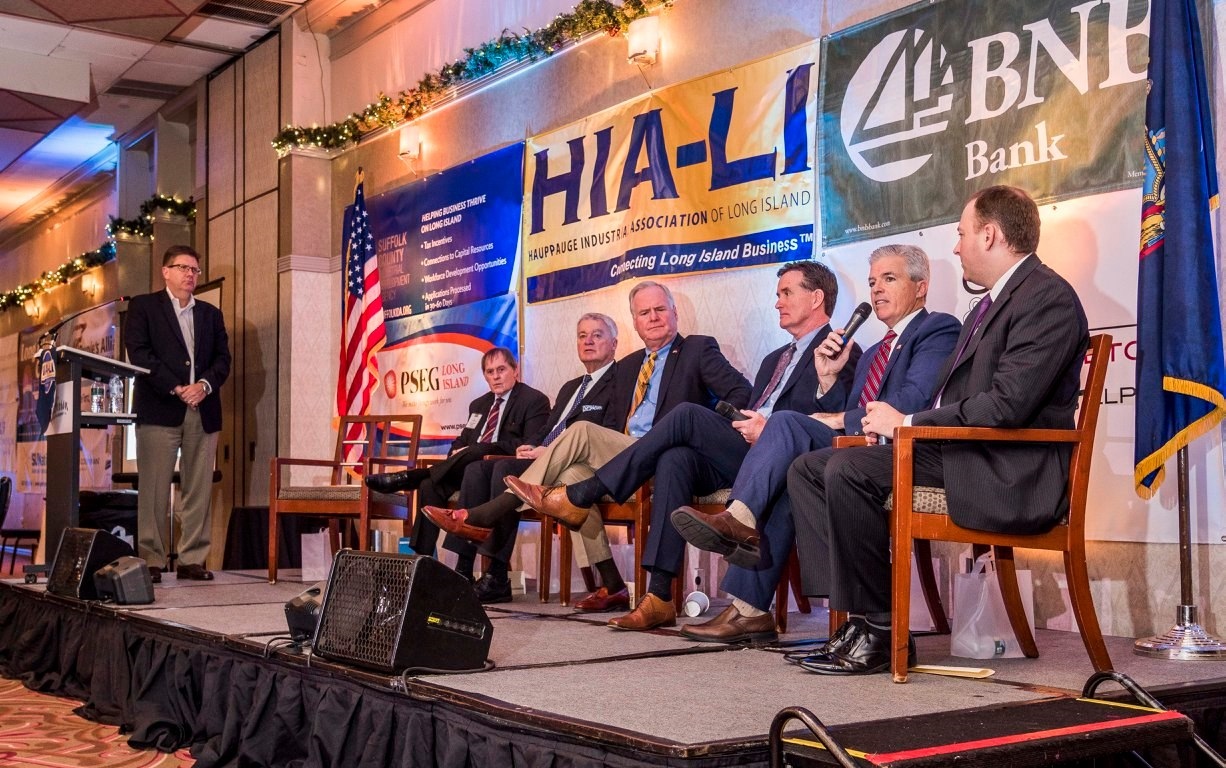
John Fitzgerald, Partner at Citrin Cooperman, reviewed the survey results and served as moderator of the panel.

Last week, over 200 business leaders gathered at HIA-LI’s 31st Annual Economic Summit to discuss the findings of our latest Economic Survey, conducted in collaboration with Citrin Cooperman and Adelphi University. This event is one of the most valuable touchpoints for our business community, providing data-driven insights that help shape strategic decisions for the year ahead.

Optimism and Challenge: Long Island’s Economic Climate

The 2025 HIA-LI Economic Survey revealed a complex economic picture—one of optimism, growth, and persistent challenges. Among the key takeaways:

  • 54 percent of business leaders believe Long Island’s economy is growing.
  • 70 percent of businesses met or exceeded their 2024 profitability goals.
  • 42 percent of businesses plan to expand their footprint on Long Island.
  • However, 71 percent of respondents cited retention of young professionals as a major concern.
  • High taxes and inflation remain top issues affecting profitability.

These findings reinforce what we see daily at HIA-LI: businesses are resilient and committed to Long Island, yet they face systemic hurdles that require strategic solutions and collaboration.

Infrastructure: A Game Changer for Economic Growth

One of the most exciting discussions of the summit centered on infrastructure investments, particularly the $150 million state investment in MacArthur Airport, announced last week by Governor Kathy Hochul. This initiative, championed by Islip Town Supervisor Angie Carpenter, will create a direct rail connection to the Long Island Rail Road, making regional travel and business operations more efficient.

Christine Flaherty, Senior Vice President of Real Estate Development and Facilities at Catholic Health, highlighted the critical role of healthcare infrastructure in supporting Long Island’s economic vitality. With Catholic Health’s continued investment in ambulatory care centers and telehealth services, the region is strengthening its healthcare ecosystem, which directly impacts business productivity and workforce retention.

Meanwhile, Rich Humann, President & CEO of H2M Architects + Engineers, emphasized how modernizing Long Island’s infrastructure through smart technology and digital transformation will be a catalyst for economic stability and business growth.

Workforce and Housing: The Retention Crisis

The top challenge facing Long Island businesses continues to be talent retention and workforce development. The survey found that 46 percent of business leaders report increasing difficulty in hiring quality candidates—nearly triple the percentage from two years ago.

The lack of affordable housing compounds this issue. John Finn, Director of Leasing and Acquisitions at Damianos Realty Group, stressed that housing affordability is at a crisis level, with local governments needing to rezone and expand housing options to keep young professionals on Long Island.

Meanwhile, Diane Manders, CEO of Habitat for Humanity of Long Island, highlighted that applications for affordable homeownership have skyrocketed by 600 percent in the past five years, signaling an urgent demand for solutions.

The Role of Finance: Navigating Inflation and Growth

Despite the positive business outlook, inflation and rising interest rates remain significant concerns. Brian Teplitz, Chief Credit Officer at Dime Bank, pointed out that while business lending remains competitive, borrowing costs are rising, and companies must adapt their financial strategies accordingly.

Yet, businesses are determined to grow. Many survey respondents indicated plans for capital improvements in 2025, with technology investments being a top priority. This reinforces the need for public-private collaboration to create policies that support business expansion while mitigating financial risks.

Bridging Business, Government, and Education

The panel discussion, moderated by John Fitzgerald, Partner at Citrin Cooperman, was dynamic and solutions-driven. It became clear that businesses, government leaders, and educational institutions must align efforts to address these challenges.

At HIA-LI, we continue to advocate for:

  • Workforce development initiatives that build talent pipelines.
  • Infrastructure expansion to enhance economic opportunities.
  • Policies that make Long Island a competitive place to live and work.

Looking Ahead: Solutions, Not Just Data

The 31st Annual Economic Summit was more than just a snapshot of Long Island’s economy—it was a call to action. We have the resources, talent, and expertise to tackle these challenges, but collaboration is key.

To every business leader, policymaker, and stakeholder who participated: thank you. Your engagement fuels the work we do. As we move forward, HIA-LI remains committed to driving solutions that ensure Long Island’s economic future is strong, sustainable, and forward-thinking.

Let’s continue the conversation. If you’re not yet involved, now is the time. Join us in shaping the future of Long Island.

To view the full Economic Survey, click here.

Trade Show Proves We’re Back to Business!

No matter the industry or the business sector – and no matter whether you’re a for-profit or not-for-profit enterprise – there’s nothing like real-world, face-to-face networking to help reinforce existing relationships and develop new relationships.

More than 2,000 participants walked the floor at the HIA-LI 34th Annual Business Trade Show and Conference on May 26.

And that leads to new business!

We were all reminded of these basic truths on May 26 at our 34th Annual Business Trade Show and Conference at Suffolk Community College in Brentwood. More than 2,000 business executives joined us to interact with more than 150 exhibitors representing just about every industry sector on Long Island: technology, energy and environment, manufacturing, finance, hospitality, healthcare, media and advertising, education, government, workforce development, and more.

The event began with a sold-out, all-star breakfast panel moderated by Marc Herbst of the Long Island Contractors’ Association. Panelists included Scott Burman of Engel Burman, Joe Campolo of Campolo Middleton & McCormick, Jim Coughlan of TRITEC, and Richard Zapolski of Cameron Engineering.

The panel zeroed in on one of the most exciting and ambitious projects taking shape on Long Island today: Midway Crossing in Ronkonkoma.

The $2.8-billion, public/private project would create a transportation-oriented hub comprised of 1.4 million square feet of office space geared toward bio-tech, research, healthcare and STEM education. It would also include a convention center with a 108,000-square-foot exhibit hall, a 30,000-square-foot ballroom, and 20,000 square feet of meeting rooms.

Plans for Midway Crossing also encompass a 300-room hotel, 250,000 square feet of retail and restaurant space, and a new, 300,000-square-foot terminal at Islip MacArthur Airport that would connect to the Ronkonkoma LIRR station.

Panelists agreed that Midway Crossing stands to be a transformational project for the Long Island economy, generating thousands of jobs and helping to better integrate Long Island’s transportation infrastructure on a big-picture basis – and for the long term.

Making Midway Crossing a reality is going to require energetic advocacy on the part of the Long Island business community, and HIA-LI – a long-time supporter of Islip’s Long Island MacArthur Airport – plans to play an active part.

Other projects discussed include growth at the Long Island Innovation Park at Hauppauge, the Ronkonkoma Hub, downtown Bay Shore, and downtown Long Beach – all vital projects that give young professionals options to live, work, and play on Long Island.

Why is this important? Because studies show that 67 percent of young adults ages 18 to 35 and looking to leave Long Island within the next five years. And by 2025 – just three short years from now – 75 percent of our workforce will need to be young professionals.  These projects are critical to stop the brain drain that’s on the horizon.

Also, for the first time, our Trade Show featured a dedicated Manufacturing Pavilion focused on specific issues and challenges facing manufacturers.

And how do we know it was a success? We asked exhibitors, sponsors, and attendees to complete surveys that would allow us to quantify their level of satisfaction with the event. And, on a scale of one to ten, respondents gave the Trade Show a robust ranking of 8.5.

Thank you to everyone who helped contribute to the success of our 34th Annual Business Trade Show and Conference. Let’s keep the momentum going!

Working with Government from a Regional Perspective

Annual Meeting and Legislative Reception 1-17-20
From left: Joe Campolo, Managing Partner, Campolo, Middleton & McCormick, LLP and Chairman, HIA-LI Board of Directors; Smithtown Supervisor Ed Wehrheim; Islip Town IDA Executive Director Bill Mannix; Assemblyman Mike Fitzpatrick; State Senator John Flanagan; County Executive Steve Bellone; and, Congressman Lee Zeldin.

To maintain Long Island’s economic competitiveness for the long run, the public sector needs to maintain a rich dialogue with the private sector.

That’s why HIA-LI takes pride in hosting forums where business and government come together to exchange ideas and to highlight the region’s centers of economic development opportunity.

A classic example was the 42nd HIA-LI Annual Meeting and Legislative Breakfast held January 17 at the Radisson Hotel in Hauppauge.

Attended by more than 350 representatives of Long Island’s business community, our high-octane panel of public officials included Congressman Lee Zeldin, State Senator John Flanagan, Assemblyman Mike Fitzpatrick, Suffolk County Executive Steve Bellone, Smithtown Town Supervisor Ed Wehrheim, and Bill Mannix, Executive Director of the Islip Town IDA.

Moderator Joe Campolo, Managing Partner of Campolo, Middleton & McCormick, LLP and Chairman of HIA-LI’s Board of Directors, emphasized the large percentage of businesses at the Long Island Innovation Park at Hauppauge engaged in value-added “tradeable” sectors exporting goods and services out of the region.

The Park’s “tradeability” ratio ranks “20 percent above the national average” for similar business clusters.

Congressman Zeldin praised Brookhaven National Lab for securing a $2-billion federal award to build an Electron Ion Collider, a project will “inject billions of dollars and an extensive number of jobs into Long Island’s economy.”

Senator Flanagan said his focus in Albany this year would be to “maximize education funding, capital investments such as roads and bridges, and increase funding for the LIRR via the MTA.”

State government must do more to relieve fiscal burdens on localities, said Assemblyman Fitzpatrick, by curtailing its “cost-shifting” practices.

County Executive Bellone highlighted the Nicolls Road Corridor’s role as a platform for the revitalization of Patchogue, the forthcoming Ronkonkoma Hub, new growth at Long Island MacArthur Airport, and the ever-expanding Stony Brook University.

The Long Island Innovation Park at Hauppauge is on a multi-track growth trajectory, said Supervisor Wehrheim, because state, county, and town governments have “put politics aside” and built consensus on success strategies for the Park.

Sewer expansion is key to Suffolk County’s economic growth, said Bill Mannix, citing a recent $10-million state grant to the Town of Islip to extend sewer lines into downtown communities.

As HIA-LI members spend each day focused on growing our own individual enterprises, we also understand the importance of viewing our work within a regional perspective. As evidenced by our Legislative Breakfast, Long Island is fortunate to be represented by elected officials who also understand the value of long-term regional growth.