The Next Business Breakthrough Starts with a Conversation

One of my favorite stories about the power of the HIA-LI Trade Show goes back many years.

Before joining HIA-LI, I was exhibiting at this very trade show on behalf of my former employer when I struck up a conversation with a senior executive from Computer Associates. It was a chance encounter. One of the countless conversations that take place on a trade show floor each year. But that single conversation eventually led to one of the largest contracts in that company’s history.

It’s a reminder that you never know where your next opportunity, partnership, client, or breakthrough idea will come from.

That story was very much on my mind as more than 4,000 business professionals gathered at Suffolk Credit Union Arena at Suffolk County Community College for HIA-LI’s 38th Annual Business Trade Show & Conference.

Featuring more than 375 exhibitors, this year’s event embraced the theme, “The Next Business Breakthrough.” Judging by the energy on the trade show floor, the packed networking events, and the meaningful conversations taking place throughout the day, there were plenty of breakthroughs happening.

Connections That Create Opportunity

The event also received strong reviews from participants, with more than 70 percent of survey respondents rating their experience an eight or higher on a 10-point scale.

Denise Labosco of Suite AI Solutions, a first-time exhibitor, described the event as “extremely organized” and praised the quality of the attendees, noting that she walked away with “real conversations and real leads.”

Returning exhibitor Alice Thomson of Southampton Inn said she was glad her organization returned for a second year, citing the meaningful connections she expects will lead to future business opportunities.

Those comments reflect what has made the HIA-LI Trade Show such a valued annual tradition for nearly four decades. While the exhibitors, industries, and business challenges may evolve over time, the power of bringing people together remains unchanged.

More Than Networking: A Conversation About Long Island’s Future

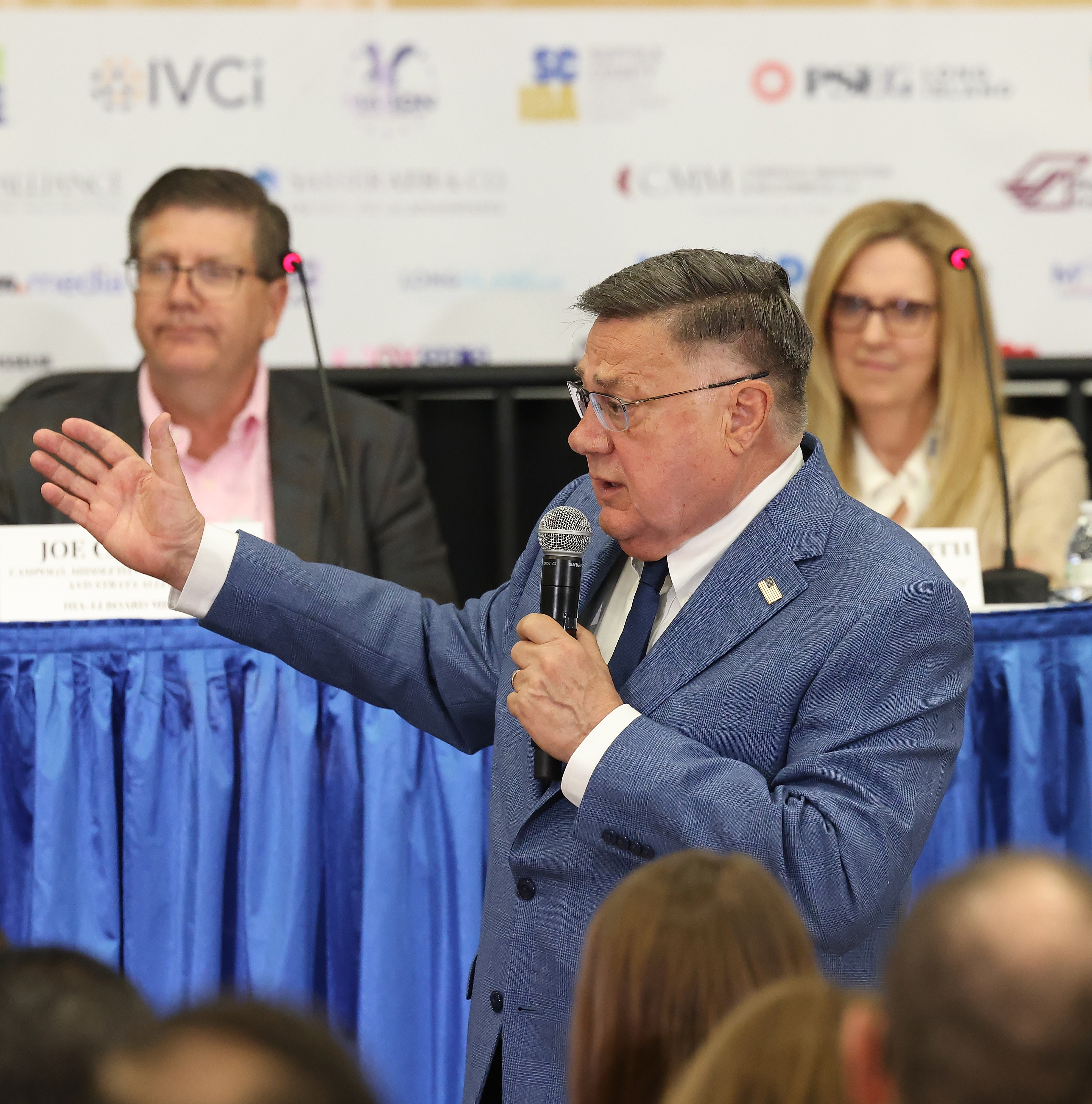
While the trade show floor was buzzing throughout the day, one of the highlights was the Executive Luncheon, “Economic Development: Reshaping Long Island’s Landscape.”

Moderated by Marc Herbst, Executive Director of the Long Island Contractors’ Association, the luncheon featured a special welcome by video from Governor Kathy Hochul and opening remarks by Suffolk County Executive Ed Romaine. The panel included Joe Campolo, Managing Partner of Campolo, Middleton & McCormick LLP, Founder of STRATA Alliance, and HIA-LI Board Member; Jim Coughlan, Co-Founder and Principal of TRITEC Real Estate and HIA-LI Board Member; Cara Longworth, Regional Director of Empire State Development; and Paul Pontieri, Mayor of the Village of Patchogue.

Although each panelist brought a different perspective, a common theme emerged throughout the discussion: Long Island’s future depends on our ability to create places where people can live, work, innovate, and build businesses.

The conversation touched on some of the most important issues facing our region, including workforce development, housing, innovation, infrastructure investment, downtown revitalization, and economic competitiveness.

Panelists discussed major projects already transforming Long Island, from transit-oriented development and downtown redevelopment initiatives to emerging innovation corridors designed to help turn research and new technologies into businesses and jobs. They emphasized that economic development is no longer about a single project or a single community. Success depends on collaboration among government, business, developers, educational institutions, and community leaders working toward a shared vision for the region.

Turning Ideas Into Action

One particularly important theme was the connection between housing and workforce development. Businesses cannot attract and retain talent if workers cannot afford to live where they work. Likewise, innovation cannot thrive if promising startups and skilled professionals leave the region in search of opportunities elsewhere.

The discussion also highlighted the importance of investing in quality-of-life initiatives that make Long Island an attractive place to live, raise a family, launch a business, and pursue a career.

What made the luncheon especially valuable was that it moved beyond identifying challenges. The panelists offered real-world examples of projects, partnerships, and strategies already producing results and creating momentum for the future.

That spirit of collaboration carried throughout the entire trade show.

Every year, the HIA-LI Trade Show brings together business leaders, entrepreneurs, nonprofits, government officials, educators, and innovators from across Long Island. It creates opportunities to share ideas, build relationships, and discover solutions to common challenges.

Most importantly, it reminds us that Long Island’s greatest asset is not a building, a development project, or even a business sector. It is the people willing to come together, exchange ideas, and work toward a stronger future.

And that is where the next business breakthrough often begins.

Growth, Grit, and the Policy Path Forward

If this year’s HIA-LI Economic Summit made one thing clear, it is this: Long Island’s business community is not waiting for permission to grow.

Before some 250 business leaders gathered to “Survey the Pulse of Long Island,” the energy in the room was unmistakable. There was discipline. There was realism. And above all, there was readiness.

The data from our 2026 Business Climate Survey, conducted in partnership with Citrin Cooperman and Adelphi University, tells that story clearly. Fifty-eight percent of respondents plan to expand in 2026. More than two-thirds anticipate growth over the next five years. Nearly half are planning capital improvements this year alone.

Those are not defensive numbers. They are forward-looking numbers.

They reflect confidence in Long Island’s economic foundation and belief in what comes next. When challenged, this region does not retreat. It recalibrates and moves forward.

I remain deeply grateful to our survey partners. Citrin Cooperman’s analytical leadership and Adelphi University’s academic collaboration ensure that our conversations are grounded in measurable reality. We are not speculating about the pulse of Long Island. We are measuring it.

CAUTIOUS DOES NOT MEAN WEAK

While 45 percent of respondents forecast revenue growth in 2026, the tone of the morning was less about exuberance and more about intentional positioning. Under the thoughtful moderation of John Fitzgerald, Partner at Citrin Cooperman, the discussion underscored a critical distinction: prudence is not pessimism.

What I heard was strategy.

Balance sheets are strong. Liquidity remains healthy. Investment in artificial intelligence is accelerating. Companies are strengthening operations and planning for sustainable expansion. That is not hesitation. That is resilience with purpose.

PUBLIC INVESTMENT MUST UNLOCK PRIVATE MOMENTUM

Governor Kathy Hochul’s Long Island Assistant Secretary for Intergovernmental Affairs, Rob Calarco, outlined the governor’s priorities, including middle-class tax relief, child care expansion, insurance reform and significant economic development commitments.

Most notable for our region was the emphasis on sustained investment in water infrastructure, including sewer and clean water projects designed to unlock housing development.

Infrastructure policy does not always capture headlines, but it determines whether growth is possible. Without sewer capacity and clean water systems, housing approvals stall. Without housing, workforce retention suffers. Without workforce stability, business expansion slows.

Water infrastructure is not abstract policy. It is the lever that enables economic mobility and regional competitiveness.

The encouraging signal is this: public investment is aligning around affordability and growth. The responsibility now is execution.

HOUSING IS THE MULTIPLIER

If one issue connected nearly every industry represented on the panel, it was housing.

The message was consistent across sectors. Without attainable housing, attracting young professionals becomes more difficult. Retaining families becomes harder. Scaling employers becomes constrained.

James Coughlan, Executive Vice President and Partner of TRITEC Real Estate, reinforced this point clearly. Housing production is not simply a development conversation. It is a competitiveness strategy.

Our survey confirms that business leaders understand this reality. Forty percent identified housing affordability as the most important area for government investment to facilitate growth.

Housing is not a siloed policy conversation. It is an economic multiplier. When supply expands and approvals move predictably, the ripple effects touch healthcare staffing, education, small business growth and long-term investment.

WORKFORCE STRATEGY MUST BE INTENTIONAL

Housing alone will not solve our workforce challenges. Talent pipelines must be built deliberately and sustained over time.

Throughout the discussion, the need for earlier engagement between industry and education surfaced repeatedly. Rich Humann, President and CEO of H2M Architects + Engineers and HIA-LI Board Member, emphasized that waiting until college to expose students to career pathways is too late. If we want engineers, designers, project managers and skilled trades professionals to remain on Long Island, those pathways must begin in K–12 classrooms.

That philosophy aligns directly with the work of HIA-LI’s Workforce Development Task Force, co-chaired by Humann and Suffolk County Community College President Dr. Edward Bonahue. Identifying labor shortages is not enough. Structured, visible and accessible pipelines must follow.

In healthcare, the urgency is even more pronounced. Christopher Nelson, President of St. Catherine of Siena Hospital, described rising demand for services colliding with workforce shortages and reimbursement pressures. We are training talented clinicians here. Policy and affordability must make it possible for them to build their careers here as well.

Higher education is navigating its own structural shifts. Dr. Christopher Storm, Interim President of Adelphi University, pointed to demographic headwinds and federal aid changes reshaping enrollment patterns. At the same time, institutions like Adelphi remain foundational to Long Island’s economic vitality. They produce first-generation graduates, train nurses and teachers, and prepare students for a workforce increasingly shaped by artificial intelligence.

From the financial perspective, the fundamentals remain strong. Kevin Santacroce, Chief Banking Officer of ConnectOne Bank and HIA-LI Board Member, reinforced that Long Island businesses are disciplined, well-capitalized and positioned for expansion. Entrepreneurial energy is intact. What business leaders need is predictability in the policy environment.

And any workforce strategy must remain grounded in household realities. Rick Lewis, Chief Executive Officer of the Suffolk Y JCC, reminded us that rising food pantry usage and cautious donor behavior reflect ongoing financial pressure on families. Economic expansion must translate into community stability.

Workforce strategy, in other words, is the connective tissue between housing, education, healthcare and business growth.

INNOVATION WITH RESPONSIBILITY

Nearly 60 percent of survey respondents believe artificial intelligence will positively impact their operations this year, and more than half have already invested in AI tools.

The discussion reflected maturity rather than hype. Leaders are embracing efficiency gains while recognizing that cybersecurity vigilance and governance must accompany innovation. Technology can amplify productivity, but it cannot replace thoughtful leadership or sound policy frameworks.

WHAT THIS MOMENT REQUIRES

After listening carefully to every perspective in the room, my conclusion is clear.

Long Island is aligned.

Businesses are prepared to expand. Infrastructure investment is underway. Educational institutions are adapting. Financial institutions are stable. The entrepreneurial spirit remains intact.

We know the pressure points. Housing approvals must move faster. Workforce pipelines must strengthen. Regulatory frameworks must facilitate development rather than delay it. Infrastructure investment must translate into tangible progress.

Long Island has always thrived when public and private leadership move in the same direction. That alignment was palpable at this year’s Summit.

The pulse of Long Island is strong. The foundation is in place. With focused policy action and continued collaboration, we have the opportunity to convert readiness into sustained, confident growth.

Because strong policy begins with strong data, I encourage you to explore the full findings in our 2026 Business Climate Survey.

To read the full Business Climate Survey, click here.

Long Island’s Economic Landscape: Insights from HIA-LI’s 31st Annual Economic Summit

John Fitzgerald, Partner at Citrin Cooperman, reviewed the survey results and served as moderator of the panel.

Last week, over 200 business leaders gathered at HIA-LI’s 31st Annual Economic Summit to discuss the findings of our latest Economic Survey, conducted in collaboration with Citrin Cooperman and Adelphi University. This event is one of the most valuable touchpoints for our business community, providing data-driven insights that help shape strategic decisions for the year ahead.

Optimism and Challenge: Long Island’s Economic Climate

The 2025 HIA-LI Economic Survey revealed a complex economic picture—one of optimism, growth, and persistent challenges. Among the key takeaways:

  • 54 percent of business leaders believe Long Island’s economy is growing.
  • 70 percent of businesses met or exceeded their 2024 profitability goals.
  • 42 percent of businesses plan to expand their footprint on Long Island.
  • However, 71 percent of respondents cited retention of young professionals as a major concern.
  • High taxes and inflation remain top issues affecting profitability.

These findings reinforce what we see daily at HIA-LI: businesses are resilient and committed to Long Island, yet they face systemic hurdles that require strategic solutions and collaboration.

Infrastructure: A Game Changer for Economic Growth

One of the most exciting discussions of the summit centered on infrastructure investments, particularly the $150 million state investment in MacArthur Airport, announced last week by Governor Kathy Hochul. This initiative, championed by Islip Town Supervisor Angie Carpenter, will create a direct rail connection to the Long Island Rail Road, making regional travel and business operations more efficient.

Christine Flaherty, Senior Vice President of Real Estate Development and Facilities at Catholic Health, highlighted the critical role of healthcare infrastructure in supporting Long Island’s economic vitality. With Catholic Health’s continued investment in ambulatory care centers and telehealth services, the region is strengthening its healthcare ecosystem, which directly impacts business productivity and workforce retention.

Meanwhile, Rich Humann, President & CEO of H2M Architects + Engineers, emphasized how modernizing Long Island’s infrastructure through smart technology and digital transformation will be a catalyst for economic stability and business growth.

Workforce and Housing: The Retention Crisis

The top challenge facing Long Island businesses continues to be talent retention and workforce development. The survey found that 46 percent of business leaders report increasing difficulty in hiring quality candidates—nearly triple the percentage from two years ago.

The lack of affordable housing compounds this issue. John Finn, Director of Leasing and Acquisitions at Damianos Realty Group, stressed that housing affordability is at a crisis level, with local governments needing to rezone and expand housing options to keep young professionals on Long Island.

Meanwhile, Diane Manders, CEO of Habitat for Humanity of Long Island, highlighted that applications for affordable homeownership have skyrocketed by 600 percent in the past five years, signaling an urgent demand for solutions.

The Role of Finance: Navigating Inflation and Growth

Despite the positive business outlook, inflation and rising interest rates remain significant concerns. Brian Teplitz, Chief Credit Officer at Dime Bank, pointed out that while business lending remains competitive, borrowing costs are rising, and companies must adapt their financial strategies accordingly.

Yet, businesses are determined to grow. Many survey respondents indicated plans for capital improvements in 2025, with technology investments being a top priority. This reinforces the need for public-private collaboration to create policies that support business expansion while mitigating financial risks.

Bridging Business, Government, and Education

The panel discussion, moderated by John Fitzgerald, Partner at Citrin Cooperman, was dynamic and solutions-driven. It became clear that businesses, government leaders, and educational institutions must align efforts to address these challenges.

At HIA-LI, we continue to advocate for:

  • Workforce development initiatives that build talent pipelines.
  • Infrastructure expansion to enhance economic opportunities.
  • Policies that make Long Island a competitive place to live and work.

Looking Ahead: Solutions, Not Just Data

The 31st Annual Economic Summit was more than just a snapshot of Long Island’s economy—it was a call to action. We have the resources, talent, and expertise to tackle these challenges, but collaboration is key.

To every business leader, policymaker, and stakeholder who participated: thank you. Your engagement fuels the work we do. As we move forward, HIA-LI remains committed to driving solutions that ensure Long Island’s economic future is strong, sustainable, and forward-thinking.

Let’s continue the conversation. If you’re not yet involved, now is the time. Join us in shaping the future of Long Island.

To view the full Economic Survey, click here.