Fueling Long Island’s Future: A Blueprint for Smart, Sustainable Growth

At HIA-LI’s recent Economic Development Symposium, we welcomed a room full of business leaders, public officials, and visionaries who share a common belief: that Long Island’s economic future can—and must—be shaped intentionally, inclusively, and strategically.

The forum underscored what we already know to be true: sustainable economic growth doesn’t happen by chance. It’s built on a foundation of smart investments, bold leadership, and the willingness to rethink the systems we’ve inherited.

Building Livable Communities Through Collaboration

One consistent theme that emerged was the critical importance of collaboration between government and the private sector. Angie Carpenter, Supervisor of the Town of Islip, made it clear that responsible economic development must go hand-in-hand with quality-of-life investments. Her town is not only reimagining downtown Central Islip through a $10 million Downtown Revitalization Initiative but also leveraging the economic power of MacArthur Airport to create jobs and attract investment. With five airlines and 18 non-stop destinations—including new service from JetBlue and Avelo—Islip is proving that modern infrastructure is essential to regional vitality.

Economic Development with a Human Face

At the Suffolk County IDA, Kelly Murphy is driving investment that is both data-informed and community-centered. Her team helped generate over $214 million in payroll last year, through projects that didn’t just create jobs—they created careers. The IDA’s focus on “Long Island First” encourages companies to hire locally and reinvest in the region, from expanding manufacturers at the Long Island Innovation Park at Hauppauge to family-owned businesses like Casanova Meats. These aren’t abstract numbers; they’re direct investments in families, futures, and neighborhoods.

That focus on workforce development is aligned with the region’s recent progress. According to data recently announced by Governor Kathy Hochul, Long Island added 91,000 non-farm jobs between 2020 and 2024—an impressive 7.1% increase. Healthcare led the way with more than 24,000 new positions, while construction rose 10%, creating over 8,000 jobs. Even more encouraging: unemployment dropped from 4.5% to 3.8%, a signal that targeted investments are paying off across the board.

Solving the Housing Crisis: A Prerequisite for Economic Growth

No conversation about Long Island’s future can avoid the issue of housing. Jimmy Coughlan, Executive Vice President at TRITEC Real Estate, laid out the stark reality: of counties in the U.S. with a population of at least 1.5 million, Suffolk County is the second largest by area and by population, but dead last nationwide in new housing starts. Nassau County, right next door, doesn’t fare much better. Both counties lag behind high-growth regions like Charlotte, Nashville, and Raleigh—places that have embraced new development to attract and retain talent.

The consequences here are clear: young professionals are being priced out, businesses can’t attract the workforce they need, and our region’s growth potential is being constrained. The housing market, like any market, is a function of supply and demand—and on Long Island, we’re simply not producing enough supply.

But Coughlan didn’t come with just problems—he brought solutions. Smart growth. Transit-oriented development. Streamlined approvals. Flexible affordability mandates that make projects financially viable. TRITEC’s work in Bay Shore and Ronkonkoma proves that when developers and local governments work together, vibrant communities follow.

A Model for Regional Growth: The Long Island Innovation Park

In the Town of Smithtown, Supervisor Ed Wehrheim has made the Long Island Innovation Park at Hauppauge a centerpiece of his economic development agenda. The park now supports over 55,000 jobs, contributes $13 billion in economic output, and houses leading companies in sectors like aerospace, biopharma, IT, and advanced manufacturing.

Wehrheim’s vision for a “live, work, play” district—with mixed-use zoning, modern infrastructure, and expanded sewer capacity—is already attracting the younger workforce Long Island needs to stay competitive. His town’s track record—AAA bond rating, zero fiscal stress, thriving downtowns—is a model for how proactive leadership fuels prosperity.

A Call to Action

At HIA-LI, we believe in the power of partnerships. What we heard at this year’s Economic Development Symposium wasn’t just a list of projects or statistics—it was a blueprint for how to move forward as a region. It starts with embracing innovation, investing in infrastructure, building housing for every generation, and supporting the businesses that power our economy.

Long Island’s future isn’t written yet. But with bold thinking and shared purpose, we’re well on our way to building it—together.

Long Island’s Economic Landscape: Insights from HIA-LI’s 31st Annual Economic Summit

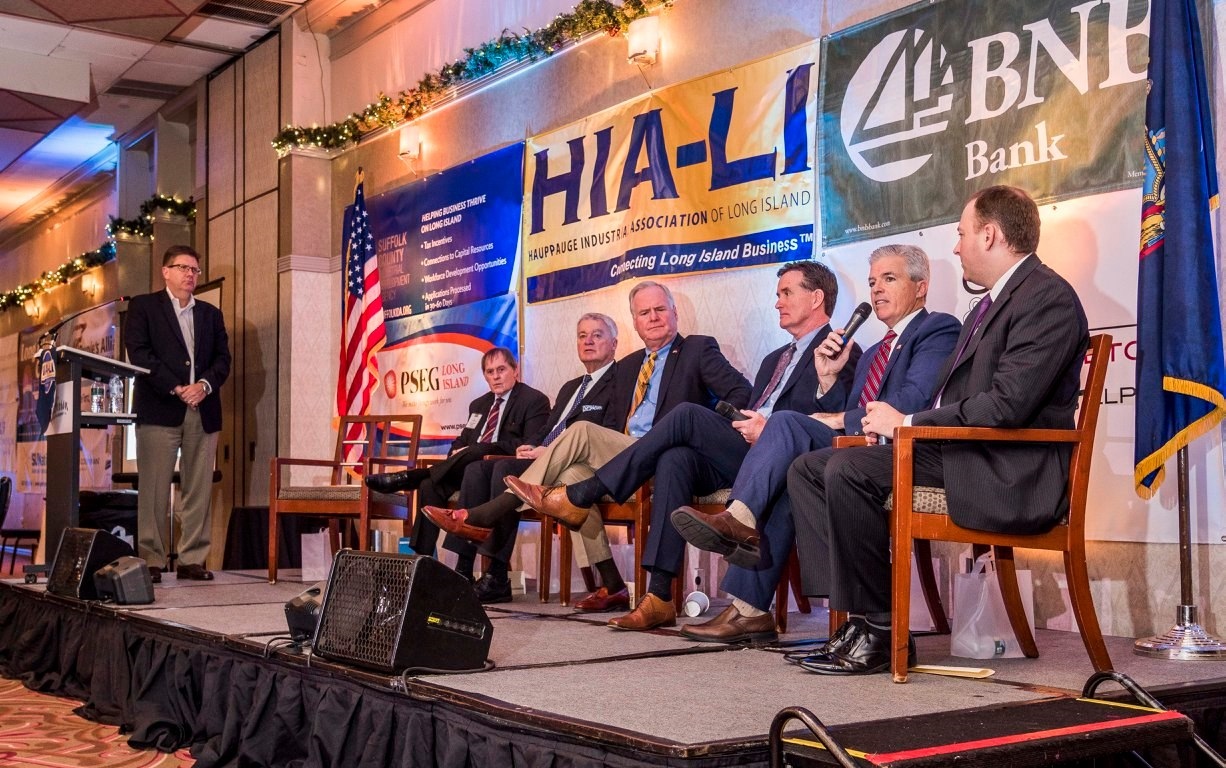
John Fitzgerald, Partner at Citrin Cooperman, reviewed the survey results and served as moderator of the panel.

Last week, over 200 business leaders gathered at HIA-LI’s 31st Annual Economic Summit to discuss the findings of our latest Economic Survey, conducted in collaboration with Citrin Cooperman and Adelphi University. This event is one of the most valuable touchpoints for our business community, providing data-driven insights that help shape strategic decisions for the year ahead.

Optimism and Challenge: Long Island’s Economic Climate

The 2025 HIA-LI Economic Survey revealed a complex economic picture—one of optimism, growth, and persistent challenges. Among the key takeaways:

  • 54 percent of business leaders believe Long Island’s economy is growing.
  • 70 percent of businesses met or exceeded their 2024 profitability goals.
  • 42 percent of businesses plan to expand their footprint on Long Island.
  • However, 71 percent of respondents cited retention of young professionals as a major concern.
  • High taxes and inflation remain top issues affecting profitability.

These findings reinforce what we see daily at HIA-LI: businesses are resilient and committed to Long Island, yet they face systemic hurdles that require strategic solutions and collaboration.

Infrastructure: A Game Changer for Economic Growth

One of the most exciting discussions of the summit centered on infrastructure investments, particularly the $150 million state investment in MacArthur Airport, announced last week by Governor Kathy Hochul. This initiative, championed by Islip Town Supervisor Angie Carpenter, will create a direct rail connection to the Long Island Rail Road, making regional travel and business operations more efficient.

Christine Flaherty, Senior Vice President of Real Estate Development and Facilities at Catholic Health, highlighted the critical role of healthcare infrastructure in supporting Long Island’s economic vitality. With Catholic Health’s continued investment in ambulatory care centers and telehealth services, the region is strengthening its healthcare ecosystem, which directly impacts business productivity and workforce retention.

Meanwhile, Rich Humann, President & CEO of H2M Architects + Engineers, emphasized how modernizing Long Island’s infrastructure through smart technology and digital transformation will be a catalyst for economic stability and business growth.

Workforce and Housing: The Retention Crisis

The top challenge facing Long Island businesses continues to be talent retention and workforce development. The survey found that 46 percent of business leaders report increasing difficulty in hiring quality candidates—nearly triple the percentage from two years ago.

The lack of affordable housing compounds this issue. John Finn, Director of Leasing and Acquisitions at Damianos Realty Group, stressed that housing affordability is at a crisis level, with local governments needing to rezone and expand housing options to keep young professionals on Long Island.

Meanwhile, Diane Manders, CEO of Habitat for Humanity of Long Island, highlighted that applications for affordable homeownership have skyrocketed by 600 percent in the past five years, signaling an urgent demand for solutions.

The Role of Finance: Navigating Inflation and Growth

Despite the positive business outlook, inflation and rising interest rates remain significant concerns. Brian Teplitz, Chief Credit Officer at Dime Bank, pointed out that while business lending remains competitive, borrowing costs are rising, and companies must adapt their financial strategies accordingly.

Yet, businesses are determined to grow. Many survey respondents indicated plans for capital improvements in 2025, with technology investments being a top priority. This reinforces the need for public-private collaboration to create policies that support business expansion while mitigating financial risks.

Bridging Business, Government, and Education

The panel discussion, moderated by John Fitzgerald, Partner at Citrin Cooperman, was dynamic and solutions-driven. It became clear that businesses, government leaders, and educational institutions must align efforts to address these challenges.

At HIA-LI, we continue to advocate for:

  • Workforce development initiatives that build talent pipelines.
  • Infrastructure expansion to enhance economic opportunities.
  • Policies that make Long Island a competitive place to live and work.

Looking Ahead: Solutions, Not Just Data

The 31st Annual Economic Summit was more than just a snapshot of Long Island’s economy—it was a call to action. We have the resources, talent, and expertise to tackle these challenges, but collaboration is key.

To every business leader, policymaker, and stakeholder who participated: thank you. Your engagement fuels the work we do. As we move forward, HIA-LI remains committed to driving solutions that ensure Long Island’s economic future is strong, sustainable, and forward-thinking.

Let’s continue the conversation. If you’re not yet involved, now is the time. Join us in shaping the future of Long Island.

To view the full Economic Survey, click here.

Working with Government from a Regional Perspective

Annual Meeting and Legislative Reception 1-17-20
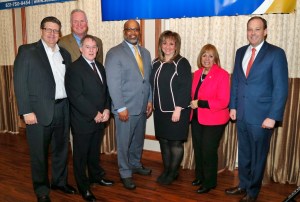
From left: Joe Campolo, Managing Partner, Campolo, Middleton & McCormick, LLP and Chairman, HIA-LI Board of Directors; Smithtown Supervisor Ed Wehrheim; Islip Town IDA Executive Director Bill Mannix; Assemblyman Mike Fitzpatrick; State Senator John Flanagan; County Executive Steve Bellone; and, Congressman Lee Zeldin.

To maintain Long Island’s economic competitiveness for the long run, the public sector needs to maintain a rich dialogue with the private sector.

That’s why HIA-LI takes pride in hosting forums where business and government come together to exchange ideas and to highlight the region’s centers of economic development opportunity.

A classic example was the 42nd HIA-LI Annual Meeting and Legislative Breakfast held January 17 at the Radisson Hotel in Hauppauge.

Attended by more than 350 representatives of Long Island’s business community, our high-octane panel of public officials included Congressman Lee Zeldin, State Senator John Flanagan, Assemblyman Mike Fitzpatrick, Suffolk County Executive Steve Bellone, Smithtown Town Supervisor Ed Wehrheim, and Bill Mannix, Executive Director of the Islip Town IDA.

Moderator Joe Campolo, Managing Partner of Campolo, Middleton & McCormick, LLP and Chairman of HIA-LI’s Board of Directors, emphasized the large percentage of businesses at the Long Island Innovation Park at Hauppauge engaged in value-added “tradeable” sectors exporting goods and services out of the region.

The Park’s “tradeability” ratio ranks “20 percent above the national average” for similar business clusters.

Congressman Zeldin praised Brookhaven National Lab for securing a $2-billion federal award to build an Electron Ion Collider, a project will “inject billions of dollars and an extensive number of jobs into Long Island’s economy.”

Senator Flanagan said his focus in Albany this year would be to “maximize education funding, capital investments such as roads and bridges, and increase funding for the LIRR via the MTA.”

State government must do more to relieve fiscal burdens on localities, said Assemblyman Fitzpatrick, by curtailing its “cost-shifting” practices.

County Executive Bellone highlighted the Nicolls Road Corridor’s role as a platform for the revitalization of Patchogue, the forthcoming Ronkonkoma Hub, new growth at Long Island MacArthur Airport, and the ever-expanding Stony Brook University.

The Long Island Innovation Park at Hauppauge is on a multi-track growth trajectory, said Supervisor Wehrheim, because state, county, and town governments have “put politics aside” and built consensus on success strategies for the Park.

Sewer expansion is key to Suffolk County’s economic growth, said Bill Mannix, citing a recent $10-million state grant to the Town of Islip to extend sewer lines into downtown communities.

As HIA-LI members spend each day focused on growing our own individual enterprises, we also understand the importance of viewing our work within a regional perspective. As evidenced by our Legislative Breakfast, Long Island is fortunate to be represented by elected officials who also understand the value of long-term regional growth.

LI MacArthur Airport and Tourism: Economic Generators for Long Island

It was a full-house at the March 22 event at Long Island MacArthur Airport, “Taking Business and Tourism to New Heights.”

It’s hard to beat tourism as a business booster.

Economic development professionals will always tell you that one of the best ways for any community to attract incoming dollars is through tourism.

Similar to the benefit enjoyed when customers outside your area purchase your exported products, a dollar spent by a visiting tourist represents the introduction of new, net wealth into your locality.

It’s a pure win, because it’s fresh, outside money coming in.

And the good news is that Long Island business and government leaders know and appreciate this fact. Moreover, they take concrete action to promote and support tourism as a means of enriching the Nassau and Suffolk economies.

To further sharpen our business community’s understanding of the symbiosis uniting tourism and business, HIA-LI hosted more than 200 members of the regional business community at a breakfast panel at Long Island MacArthur Airport on Friday, March 22. The event was called “Taking Business and Tourism to New Heights.”

The panel highlighted Long Island MacArthur Airport, which is owned and operated by  the Town of Islip, and Discover Long Island, the agency formally designated to promote Long Island as a destination for tourism, meetings, conventions, and sporting events.

Speakers included Kristen Jarnagin, President and CEO of Discover Long Island; Town of Islip Supervisor Angie Carpenter; Airport Commissioner Shelley LaRose-Arken.

Ms. Jarnagin helped to crystallize the theme of the event with the following economic development proverb:

“If you build a place where people want to visit, you will build a place where people want to live,” she said. “And if you build a place where people want to live, you will build a place where people want to work. And if you build a place where people want to work, you will build a place where business will want to be. And if businesses want to be there, you will build a place where people will want to visit.”

Thanks to Discover Long Island data, attendees learned that travelers spent an eye-opening $5.9 billion on Long Island in 2017.

And on the fiscal side, tourism in Long Island generated $722 million in state and local taxes in 2017. And sales, property, and hotel bed taxes contributed to nearly $400 million in local taxes.

By fortifying Long Island’s tax base, the tourism industry enhances the region’s ability to attract and retain private companies.

As most readers know, MacArthur Airport is an indispensable hub of our area’s tourism sector. The airport sees more than 5,000 people fly in and out every day.

And under the leadership of Supervisor Carpenter, herself a former businesswoman, the 1,300-acre airport has systematically maintained strong ties to our area’s business community.

Airport Commissioner LaRose-Arken told attendees that MacArthur ranked as America’s fastest-growing, medium- to large-sized airport, as measured by domestic seats.

She also noted that both Southwest and American Airlines had recently responded to growing demand by introducing larger aircraft, and that Frontier Airlines had expanded its list of destinations reachable from the airport.

“We try to operate our airport like a business,” said the Commissioner. “And over the last four years, the airport has run a surplus.”

Underscoring our business community’s commitment to tourism, several private-sector players recently helped underwrite a Discover Long Island survey designed to help inform future strategies for the industry’s growth.

HIA-LI, National Grid, and the Manufacturing Consortium of Long Island – which also goes by the name of Ignite Long Island – joined forces with Long Island University and Long Island MacArthur Airport to sponsor the project.

As reported by Newsday, the Discover Long Island analysis found that when travelers are told about “the Island’s beaches and parks, museums, restaurants, and other attractions, the likelihood they will visit rose to 65 percent compared with 47 percent when they knew little about the region.”

To further bolster region-wide tourism, Discover Long Island in 2017 initiated its first-ever co-marketing partnership with New York City’s tourism agency, NYC & Co. The joint program positions Long Island as “a great addition to New York City trips” and as the city’s “beachfront backyard.”

During a question-and-answer session, Ms. Jarnagin urged event attendees to always remember to speak positively about Long island.

“Please think about the way you’re speaking about your home and where you live,” she said. “Because when you put something online, people see it all over the world. If everyone hears something negative, why would anyone want to come here?”

Supervisor Carpenter also urged business leaders to make their presence felt at public hearings and speak up in support of development initiatives “because the naysayers are always going to be there.”

We need to work collaboratively with institutions and government entities.  For example, HIA-LI had provided assistance to MacArthur Airport in assessing travel patterns and passenger needs when the air facility had been scoping out growth strategies.

We simply can’t underestimate the value of this airport and tourism in strengthening the economic foundation of Nassau and Suffolk counties.  The deeper the commitment we make to tourism, the more tourism delivers to our business community.

Partnership Between HIA-LI and Town of Smithtown Delivers Long-Term Benefits to the Hauppauge Industrial Park

20190312_102207 (1)
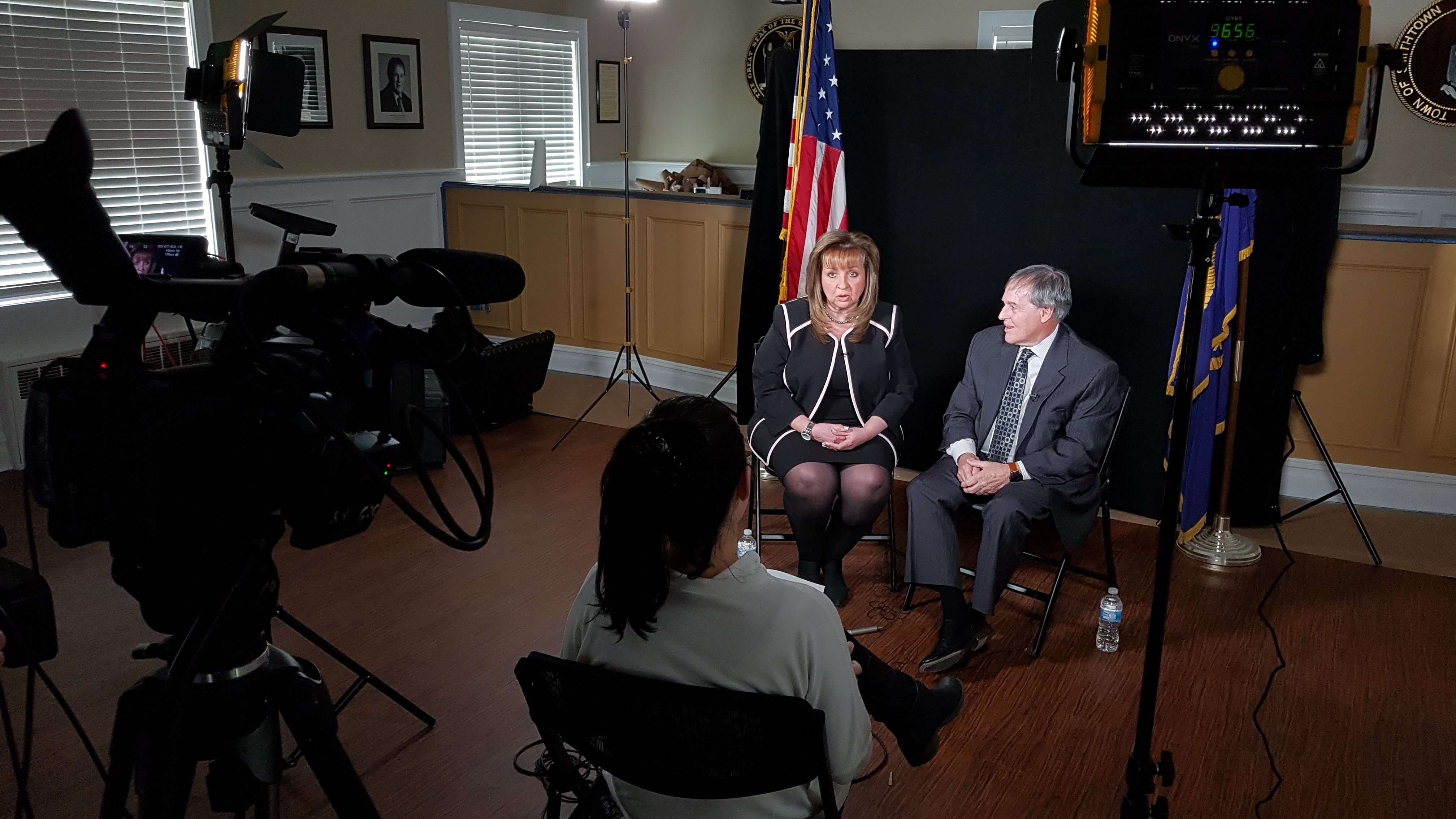
HIA-LI President & CEO Terri Alessi-Miceli is interviewed with Smithtown Supervisor Ed Wehrheim for an upcoming episode of Smithtown Spotlight.

Especially at the local level, you can’t underestimate the importance of the relationship between business and government.

We see it all the time at HIA-LI, where our ability to meet the day-to-day needs of our members – and to achieve our long-term goals – depends upon the quality of our interactions with local municipalities.

The large majority of the Hauppauge Industrial Park (HIP) is situated within the Town of Smithtown, with the balance in the Town of Islip. Happily, we enjoy vigorous support from the elected leaders of both towns.

They are Smithtown Supervisor Ed Wehrheim and Town of Islip Supervisor Angie Carpenter. Both deserve great credit for their support for the Park.

I recently was privileged to join one of these two officials, Supervisor Wehrheim, as a guest on Smithtown Spotlight, on Channel 18 in Smithtown, which is scheduled to air in April 2019.

During the interview, he repeatedly underscored the value of the Town of Smithtown’s partnership relationship with the HIA-LI and the Park.

“From ‘day one,’ we realized how important the Hauppauge Industrial Park is to the sustainability of Smithtown itself,” the Supervisor – elected in November 2017 – said. “There’s a great opportunity for us to partner, and we went full steam ahead to make sure that this happened in this administration.”

Living up to his commitment, for example, Supervisor Wehrheim has been a regular presence at HIP Task Force meetings and activities, where we are devising ways to maximize growth and competitiveness. Institutional participants include Stony Brook University, the Suffolk County IDA, and the Regional Plan Association.

In the past, the Town had done much road reconstruction work associated with the County’s sewer expansion in the Park. I was very pleased to learn that the Supervisor budgeted for several much-needed infrastructure projects including widening Adams Avenue, improving New Highway, upgrading traffic signals, adding new sidewalks, and removing outdated-looking wooden poles. And going forward, future capital improvements, he said, would be budgeted in on an annual basis.

“Even though it is infrastructure work,” he said, “these are all things that will aesthetically make the park very pleasing to business people when they come in to look at it.”

In 2018, Smithtown gave the green light to 740,000 square feet of commercial development in the Park.

Zoning changes have boosted building height limits from 35 feet to 62 feet high along Motor Parkway, with the future prospect of higher structures more deeply into the park.

“New height requirements are going to bring more high-tech businesses to the Park,” he said.

The Supervisor and I also discussed our HIP re-branding initiative which includes a possible name change for Park.  We also talked about potential zoning changes to allow residential development within the HIP.

Supervisor Wehrheim offered some concrete evidence of the Park’s fiscal value for the Town:

“We just received a Triple-A bond rating from Moody’s, the highest level that can be attained,” he said.

Moody’s cited HIP’s value in evaluating the Town’s creditworthiness, as well as Smithtown’s “partner” relationship with the Park.

With some 55,000 employees, HIP represents some $19.6 million in total tax assessed value and generates about $14 billion in annual sales.

“I see great, great things happening in the future, for the Park and for Smithtown as a whole,” said Supervisor Wehrheim. “And working with Terri has been a pleasure. It’s a great relationship to specifically accomplish great things.

“As a partnership, we’ve really stirred up some real interest and I think it’s going to continue,” he said. “At least I’m going to put all my efforts into making that happen.”

Public Officials Talk Business Growth

From left: HIA-LI Board Chairman Joe Campolo; State Assemblyman Michael Fitzpatrick, Smithtown Town Supervisor Ed Wehrheim; Suffolk Presiding Officer DuWayne Gregory; HIA-LI President & CEO Terri Alessi-Miceli; Islip Town Supervisor Angie Carpenter; and, Congressman Lee Zeldin.

Public policy has a major impact upon whether our businesses become profitable and whether our organizations succeed. That’s why HIA-LI regularly brings our members face-to-face with elected officials to discuss issues of concern to the Long Island business sector.

In this spirit, the HIA-LI convened our Annual Meeting and Legislative Breakfast on Friday, January 18 at the Hamlet Golf & Country Club in Commack.

Moderated by Board Chair Joe Campolo – Managing Partner at Campolo, Middleton & McCormick, LLP – the discussion focused on business climate issues, housing, taxes, and other topics.

Panelists included Congressman Lee Zeldin, Assemblyman Michael Fitzpatrick, Islip Town Supervisor Angie Carpenter, Smithtown Town Supervisor Ed Wehrheim, and Suffolk County Legislature Presiding Officer DuWayne Gregory.

Congressman Zeldin and Legislator Gregory cited higher education’s role in sustaining economic growth. “Unemployment is at an all-time low,” the Congressman said, “but a skills gap still exists.” He said Long Island needs a “technical training route” for non-college-bound students.

Presiding Officer Gregory praised Suffolk County Community College for “helping companies fill the skills gap.” He advocated for greater emphasis on STEM learning (science, technology, engineering, and mathematics) to help ensure the competitiveness of our regional workforce.

Supervisor Carpenter praised the Town’s Industrial Development Agency (IDA), noting its high level of accountability because the Town Board also functions as the IDA Board. She pinpointed Castella Imports of Brentwood as a big IDA success story in the Town.

Assemblyman Fitzpatrick said that high taxes – elevated by public sector pensions – have triggered out-migration from Long Island. “If government were smaller,” he said, “and pension costs were lower, we’d have a lower tax burden.”

As an economic development strategy in the Town of Smithtown, Supervisor Wehrheim reported that the Town is now situating workforce housing within business districts. Last summer, site plans were approved for such developments in Smithtown and Commack totaling 154 new units.

In today’s intensely competitive marketplace, the public and private sectors must collaborate and cooperate. Our Annual Legislative Breakfasts help bolster this essential, symbiotic relationship.

Thanks to everyone who helped make this breakfast event a success!